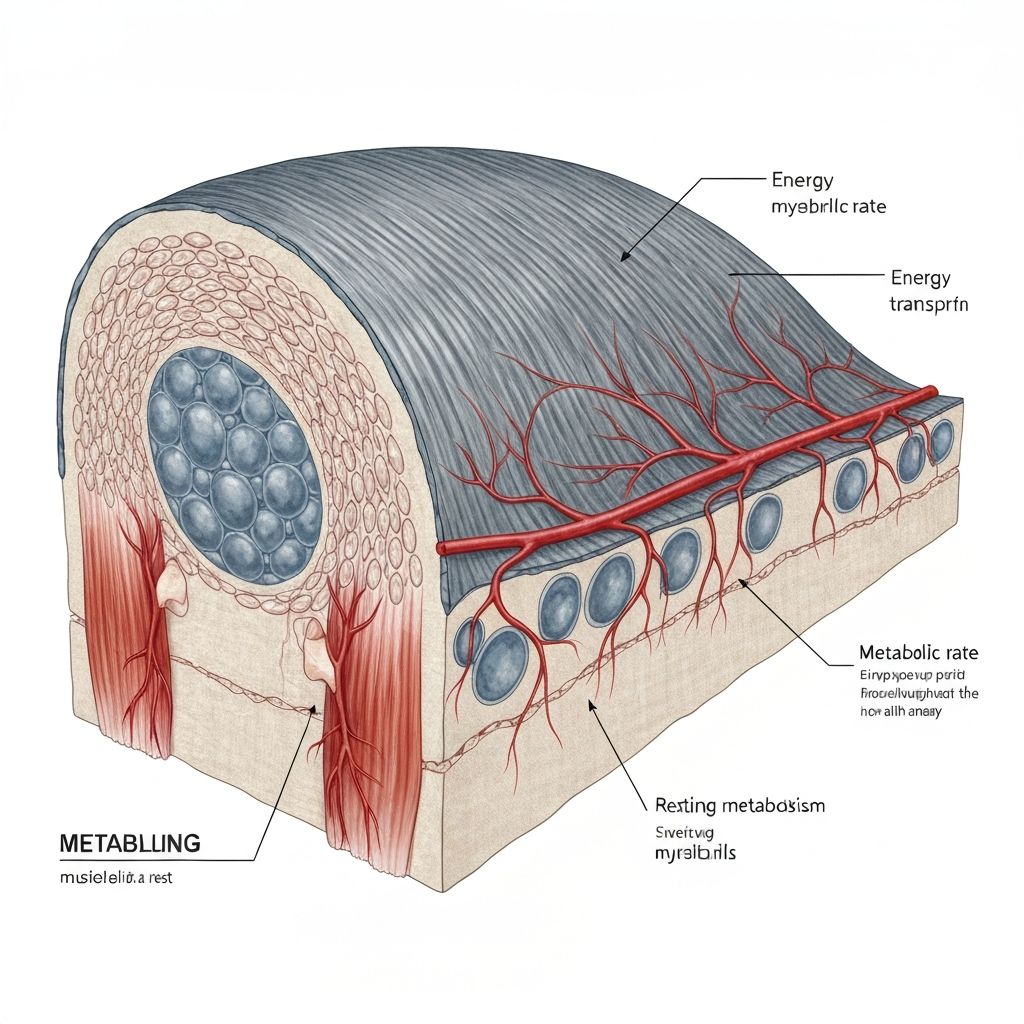
Skeletal Muscle Contribution to Resting Energy Expenditure
Skeletal muscle tissue represents one component of the body's resting metabolic rate (RMR), the amount of energy the body expends to maintain basic physiological functions at rest. Research examining body composition and energy expenditure consistently demonstrates associations between lean muscle mass and daily RMR across diverse populations. This article synthesizes findings from cross-sectional and longitudinal research on this relationship, with emphasis on methodological context and interpretation within broader metabolic frameworks.
Cross-Sectional Research Design and Findings
Cross-sectional studies comparing individuals with different body composition profiles have documented consistent associations between lean mass and resting energy expenditure. These studies typically measure body composition using techniques such as dual-energy X-ray absorptiometry (DXA), magnetic resonance imaging (MRI), or bioelectrical impedance analysis (BIA), then measure or estimate resting metabolic rate through indirect calorimetry or prediction equations. The correlations between muscle mass and RMR typically range from r = 0.40 to r = 0.70 depending on the population studied and measurement methodology employed.
However, cross-sectional associations cannot establish causation. Individuals with higher muscle mass may differ in multiple ways beyond muscle tissue alone, including genetics, physical activity patterns, nutritional status, and hormonal profiles. These unmeasured or inadequately controlled confounding variables may partially explain observed associations. Cross-sectional research generates hypotheses that require testing through experimental designs or prospective measurement.
Longitudinal Intervention Studies
Intervention trials examining changes in muscle mass and simultaneous changes in resting metabolic rate provide stronger evidence for a causal relationship. These studies typically involve training interventions lasting 8 weeks to several months, with measurements of both body composition and resting energy expenditure at baseline and post-intervention. Meta-analyses of such studies indicate that increases in lean mass from resistance training are associated with measurable increases in RMR, though the effect size is modest.
Most research suggests that skeletal muscle tissue contributes approximately 4-6 kilocalories per kilogram of mass to daily RMR, though estimates vary substantially depending on methodology. This means that gaining 1 kilogram of lean mass would be associated with an increase in RMR of approximately 4-6 kilocalories per day—a modest effect that must be placed in context of overall daily energy expenditure (typically 1500-3000 kilocalories depending on body size and activity).
Population Variability and Individual Differences
The relationship between muscle mass and RMR varies substantially across populations. Age influences the association: older adults often show weaker relationships between muscle mass and RMR compared to younger individuals, potentially due to age-related changes in muscle quality or metabolic efficiency. Sex differences exist, with some research suggesting that women show stronger associations between muscle mass and RMR than men, though other studies find no sex differences. Genetic variation influences the magnitude of the relationship, with individual variation at baseline and in response to interventions sometimes exceeding the average effect observed in populations.
Training status also matters: individuals with extensive strength training history may have different relationships between muscle mass and metabolism compared to sedentary individuals, potentially due to adaptations in mitochondrial density or muscle fiber composition that influence metabolic rate.
Contribution to Total Energy Balance
While muscle mass contributes to RMR, it is important to place this contribution in context of total energy expenditure. RMR typically accounts for 60-75% of total daily energy expenditure in sedentary individuals and smaller percentages in active individuals. Activity energy expenditure (energy used during exercise and daily movement) represents a larger portion of total expenditure for most people. The thermic effect of food (energy required for digestion) comprises approximately 10% of total expenditure. Long-term weight management depends on interactions across all components of energy balance.
Methodological Considerations
Research in this area faces several methodological challenges that should be considered when interpreting findings. Resting metabolic rate is difficult to measure precisely and is influenced by numerous acute factors including caffeine intake, sleep quality, stress, and body temperature. Studies using prediction equations rather than direct measurement introduce additional error. Measurement error in body composition assessment, particularly for individuals with unusual body types or compositions, affects results. Different studies use different measurement methodologies, making direct comparisons challenging. Publication bias may preferentially emphasize studies with positive findings, potentially overestimating true effect sizes.
Disclaimer: This website provides general educational information only. The content is not intended as, and should not be interpreted as, personalised exercise, training, or health advice. Responses to physical activity vary widely between individuals. For personal activity decisions, consult qualified healthcare or exercise professionals.
Conclusion
Research consistently demonstrates associations between skeletal muscle mass and resting metabolic rate across populations. Intervention studies suggest a causal component to this relationship, though the effect size is more modest than popular literature sometimes suggests. Muscle tissue is one of multiple contributors to daily energy expenditure, and individual variability in the relationship is substantial. Understanding these mechanisms enriches knowledge about human physiology without providing a basis for personal activity recommendations.